| |
Food Labels Understanding Them Is Critical To Your Health
Food labels contain a wealth of information about the healthfulness of
the product if you know what to look for and how to interpret them.
The packaging of a food product tells you nothing about how healthy
the product is. It tells you what the manufacturer wants you to think
about the healthfulness of the product.
Nutrition Facts
The Nutrition Facts on food labels gives you information on calories, grams of
fat, cholesterol, sodium, carbohydrates, dietary fiber, sugars, and
protein in each serving plus some percentages of a few nutrients.
What they don't tell you is that:
1 gram of fat = approximately 9 calories.
1 gram of protein = approximately 4 calories.
1 gram of carbohydrate = approximately 4 calories.
4 grams of sugar = 1 teaspoon of sugar
Here's an example to show you how to use these conversions to get
meaningful information from the Nutrition Facts on food labels:
Suppose you have a 123 calorie snack with 7 grams of fat, 2 grams of
protein and 13 grams of carbohydrate of which 12 grams of the
carbohydrate is sugar.
To get fat calories, multiply 9x7=63 calories from fat.
To get percentage of fat, divide 63 fat calories by 123 snack calories
to get 51% fat.
To get protein calories, multiply 4x2=8 calories from protein.
To get percentage of protein, divide 8 protein calories by 123 snack
calories to get 7% protein.
To get carbohydrate calories, multiply 4x13=52 calories from carbohydrate.
To get percentage of carbohydrate, divide 52 carbohydrate calories by 123 snack
calories to get 42% carbohydrate.
To get the number of teaspoons of sugar in the snack, divide 12 grams
of sugar in the snack by 4, to get 3 teaspoons of sugar.
This is good and useful information, but
not the most important you need to get from food labels about the food item.
Ingredients
The
ingredient list on food labels
is the most important bit of information on the
package. It is often hidden under a flap of packaging material in very
tiny print, just barely visible without a magnifying glass. This is
where you find out what's really in the product and how healthy it is.
But in order to understand the healthfulness of the product, you have
to know what each ingredient means. Some are straightforward, like
carrots. Some may seem straightforward, but are actually a way of
hiding harmful ingredients the manufacturer doesn't want you to know
are in the product. A good example of this is broth. It seems like a
safe ingredient unless you know that broth usually contains MSG and
that this is one way that food manufacturers hide MSG in their
products. Other ingredients may seem like Greek and you don't have
the foggiest idea of what they are, like BHT.
The main purpose of food labels is to sell the product, not tell
you what's in it. You will find the truth about how nutritious a
product is only if you know how to read and interpret the ingredients
and nutrition information on food labels. The truth about what's
really in the food you buy may shock you.
To help you understand more about the ingredients listed on food
labels,
here are some excerpts from "HOW TO READ LABELS" taken from the book,
HEALTHY EATING: For Extremely Busy People Who Don't Have Time For It.
"It frequently appears that the manufacturer is trying to hide the
ingredients in packaged foods. They make it difficult to find
the ingredients on the label, and then be able to read them. They
are often hidden under a flap of packaging material in very tiny
print. But the harder the ingredients are to find and read, usually,
the more important it is that you read them. If necessary, carry a
small magnifying glass in your pocket or purse so you know exactly
what is in a product before you decide to purchase it.
A general rule of thumb:
- If the list of ingredients is long, there's probably a lot of
chemical additives in the product, and you're risking your health
by eating it.
- If the list of ingredients is short, it may or may not have
harmful additives in it, so read the ingredients carefully before
you decide to purchase it.
Ingredients are listed on the label according to quantity; the
ingredient making up the
- largest quantity of all the ingredients is listed first
- smallest quantity is listed last
Generally only those ingredients that are required by law to
be listed on the label are listed. So, you never really know
if there are any other ingredients in the product that are
not listed on the label.
Watch out for statements like these on packages:
- NATURAL FRUIT FLAVORS, with Real Fruit Juice
- ALL NATURAL INGREDIENTS
- NO ARTIFICIAL PRESERVATIVES
- 100% NATURAL
- REAL FRUIT
- NO PRESERVATIVES
- NO ARTIFICIAL INGREDIENTS
Statements like these do not mean there are no harmful additives in
the product. There may be harmful ingredients... The manufacturer hopes
you'll think there are no harmful ingredients, but as you will see
from the following examples, it's not true. Buying a product in a
health food store does not guarantee that packaged products you buy
will be free of harmful additives either. So, it's important to
always READ LABELS VERY CAREFULLY." ...
"ALL NATURAL INGREDIENTS and NO ARTIFICIAL PRESERVATIVES ADDED
does not mean there are no harmful additives in the product.
The ingredients from a loaf of bread that states on the label
in big letters, 'ALL NATURAL INGREDIENTS,' and 'NO ARTIFICIAL
PRESERVATIVES ADDED,' are:
Enriched wheat flour (wheat flour, malted barley, niacin,
reduced iron, thiamine mononitrate, riboflavin), water, high
fructose corn syrup, yeast, wheat bran, vital
wheat gluten,
butter. Contains 2% or less of each of the following: rye
meal, corn flour, molasses, rolled whole wheat, salt, dough
conditioners (ammonium sulfate, sodium stearoyl lactylate),
brown sugar, honey, vinegar, oatmeal, soy flour, mono and
diglycerides, partially hydrogenated soybean oil.
Here is an analysis of the ingredients.
- Enriched wheat flour is white flour. The bran and the
germ portion of the whole wheat, which are rich in vitamins
and minerals, have been refined out. To compensate for
refining out approximately 20 nutrients, they add back 4
synthetic nutrients, niacin (vitamin B3), reduced iron,
thiamine mononitrate (synthetic vitamin B1), and riboflavin
(vitamin B2). These nutrient additives...are added to
mostly refined and processed foods giving a false sense of
nutritional value and can lead to nutritional imbalances.
- High fructose corn syrup is basically sugar derived from
corn. It is associated with blood sugar problems,
depression, fatigue, B-vitamin deficiency, hyperactivity,
tooth decay, periodontal disease and indigestion.
- Dough Conditioners, in general, can cause mineral
deficiencies.
- Ammonium sulfate may cause mouth ulcers, nausea, kidney
and liver problems.
- Sodium stearoyl lactylate may be corn, milk, peanut or
soy based, and may cause blood pressure and kidney
disturbances, and water retention.
- Brown sugar is frequently white sugar with molasses added.
It is associated with blood sugar problems, depression,
fatigue, B-vitamin deficiency, hyperactivity, tooth decay,
periodontal disease and indigestion.
- Mono and diglycerides may be soy, corn, peanut or fat
based. They may cause genetic changes, cancer, birth
defects, and allergic reactions.
- Partially hydrogenated soybean oil is associated with
heart disease, breast and colon cancer, atherosclerosis
and elevated cholesterol.
So, ALL NATURAL INGREDIENTS and NO ARTIFICIAL PRESERVATIVES
ADDED does
not mean there are no harmful additives in the product.
The
manufacturer hopes you'll think that, but as you can see
from the
above list of ingredients, it's not true."
To shed some more light on the safety of ingredients on food labels,
here is an excerpt from the book
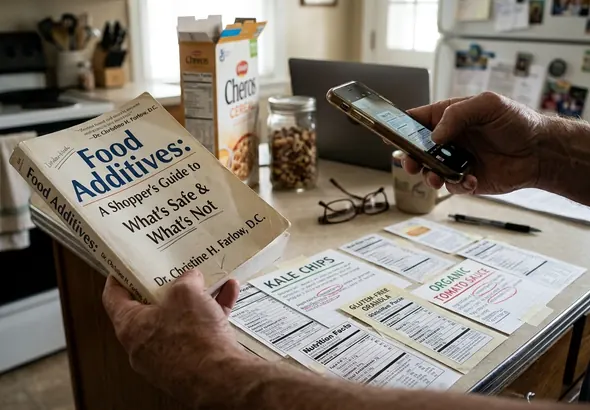
FOOD ADDITIVES: A Shopper's Guide To What's Safe & What's Not.
"There are more than 3000 different chemicals that are purposefully
added to our food supply. The testing for the safety of these
chemical additives is generally done by the company that wants to
produce the chemicals or to use the chemical additives in the foods
they produce. The Delaney Clause of the 1958 Food Additives Amendment
states that any additives shown to cause cancer in humans or animals
are not permitted to be added to our food. However, political
pressure has caused the FDA to relax these standards and allow small
amounts of cancer causing substances to be used in foods.
Even if all of the food additives used in our foods were safe
individually, rarely does any food have only one additive in it.
Testing for additive safety has been done for individual additives,
not for combinations of additives. Additives that are safe
individually may be harmful in certain combinations. Nobody knows
the effects of the many different additives used in the thousands of
different combinations."
Worst Food Additives
Here is a list of some of the worst food additives. Check food labels to make sure that what you buy does not contain these ingredients.
- Acesulfame-K - "Sunette"; may cause low blood sugar attacks; causes
cancer, elevated cholesterol in lab animals.
- Artificial colors - contribute to hyperactivity in children; may
contribute to learning and visual disorders, nerve
damage; may be carcinogenic
- Artificial sweeteners - associated with health
problems; see specific sweetener.
- Aspartame - may cause brain damage in
phenylketonurics; may cause central nervous
system disturbances, menstrual difficulties; may
affect brain development in unborn fetus.
- BHA - can cause liver and kidney damage,
behavioral problems, infertility, weakened
immune system, birth defects, cancer; should be
avoided by infants, young children, pregnant
women and those sensitive to aspirin.
- BHT - see BHA; banned in England.
- Blue No. 1 - see FD&C colors.
- Blue No. 2 - see FD&C colors.
- Brominated vegetable oil - linked to
major organ system damage, birth defects,
growth problems; considered unsafe by the FDA,
can still lawfully be used unless further action is
taken by the FDA .
- BVO - see brominated vegetable oil.
- Caffeine - psychoactive, addictive drug; may
cause fertility problems, birth defects, heart
disease, depression, nervousness, behavioral
changes, insomnia, etc.
- Citrus Red No. 2 - see FD&C colors.
- FD&C colors - colors considered safe by the FDA for use in food, drugs and cosmetics; most of the colors are derived from coal tar and must be certified by the FDA not to contain more than 10ppm of lead and arsenic; certification does not address any harmful effects these colors may have on the body; most coal tar colors are potential carcinogens, may contain carcinogenic contaminants, and cause allergic reactions.
- Free glutamates - may cause brain damage,
especially in children; always found in autolyzed
yeast, calcium caseinate, enzymes, flavors &
flavorings, gelatin, glutamate, glutamic acid,
hydrolyzed protein, hydrolyzed soy protein,
plant protein extract, protease, protease enzymes,
sodium caseinate, textured protein, yeast
extract, yeast food and yeast nutrient; may be in
barley malt, boullion, broth, carrageenan, malt
extract, malt flavoring, maltodextrin, natural
flavors, natural chicken flavoring, natural beef
flavoring, natural pork flavoring, pectin,
seasonings, soy protein, soy protein concentrate,
soy protein isolate, soy sauce, soy sauce extract,
stock, whey protein, whey protein concentrate,
whey protein isolate, anything that is enzyme
modified, fermented, protein fortified or
ultrapasteurized and foods that advertise NO
MSG; see MSG.
- Green No. 3 - see FD&C colors.
- Hydrogenated vegetable oils - associated with
heart disease, breast and colon cancer,
atherosclerosis, elevated cholesterol.
- MSG - may cause headaches, itching, nausea,
brain, nervous system, reproductive disorders,
high blood pressure; pregnant, lactating mothers,
infants, small children should avoid; allergic
reactions common; may be hidden in infant
formula, low fat milk, candy, chewing gum,
drinks, over-the-counter medications, especially
children's, binders and fillers for nutritional
supplements, prescriptiona nd non-prescription
drugs, IV fluids given in hospitals, chicken pox
vaccine; it is being sprayed on growing fruits and
vegetables as a growth enhancer; it is proposed
for use on organic crops.
- Neotame - similar to aspartame, but potentially
more toxic; awaiting approval.
- Nitrates - form powerful cancer-causing agents in stomach; can cause death; considered
dangerous by FDA but not banned because they
prevent botulism.
- Nitrites - may cause headaches, nausea,
vomiting, dizziness; see nitrates.
- Nutrasweet - see aspartame.
- Olean - see olestra.
- Olestra - causes gastrointestinal irritation,
reduces carotenoids and fat soluble vitamins in
the body.
- Partially hydrogenated vegetable oils - see
hydrogenated vegetable oil.
- Potassium bromate - can cause nervous
system, kidney disorders, gastrointestinal upset;
may be carcinogenic.
- Red No. 3 - see FD&C colors.
- Saccharin - delisted as a carcinogen in 1997,
however, studies still show that saccharin causes
cancer.
- Sulfites - destroys vitamin B1;
small amounts may cause asthma, anaphylactic
shock; dangerous for asthma, allergy sufferers;
has caused deaths; banned on fresh fruits and
vegetables, except potatoes.
- Sweet 'N Low - contains saccharin.
- Yellow No. 6 - see FD&C colors.
These are not the only harmful additives you will find on food labels.
FOOD ADDITIVES: A Shopper's Guide To What's Safe & What's Not
lists over 1300 food additives classified according to safety,
whether they may cause allergic reactions and if they are GRAS
(Generally Recognized As Safe) by the FDA. It's a handy pocket-sized book that you can carry with you when
you shop to help you read food labels and make sure that the food you're buying does not contain
any harmful ingredients.
HEALTHY EATING: For Extremely Busy People Who Don't Have Time For It
not only has detailed information about how to read and interpret
food labels, but it also tells you what's healthy and what's not in a clear,
concise and easy-to-use format. It gives you a system so easy to use
that you can't help but succeed at eating healthfully. In less than 15
minutes, you will know how to choose
healthy food
and be on the right
track to
healthy eating.
Powered by Site Build It
© copyright 2001, HealthyEatingAdvisor.com. All rights reserved.
The Healthy Eating Advisor,
P.O. Box 462335,
Escondido, CA 92046-2335
Telephone (760)735-8101
|