The first step in a beyond-organic transition is not buying a different label. It is changing the test.
A food earns its place when the body can digest it without distress, metabolize it cleanly, and absorb what it offers. That definition feels stricter than the front of a package, and in practice it is. An organic snack made with refined starch, cane sugar, gums, and seed oil can still fail the beyond-organic test because certification does not guarantee digestibility, mineral availability, or traditional preparation.
What's Inside
- What “safe food” means after swallowing
- Where standard organic labels stop helping
- How to screen dairy for casein type and heat history
- How fermented foods rebuild intestinal flora
- How to improve mineral and carotenoid absorption
- How to choose fats by stability and processing history
What Does It Mean to Go Beyond Organic?
In client kitchens, I start with a notebook before I touch the pantry. For 7 days, track food and symptoms without changing the diet. Reactions to dairy, wheat, corn, soy, additives, and high-oxalate foods become easier to separate from ordinary fluctuations when the baseline is written down.

Start with the body’s response
“Safe foods” are foods the body can break down, use, and clear without provoking avoidable stress. That includes digestion, metabolism, and absorption. It also includes the preparation method: a person may tolerate cultured A2 dairy but react to raw milk, or tolerate cooked spinach but flare after raw spinach smoothies; preparation method can matter as much as the ingredient name.
The practical first pass is simple: keep daily staples to foods with 1 to 5 recognizable ingredients. Reserve longer ingredient panels for occasional use only.
Screen the label in the right order
Read the ingredient panel before trusting the organic seal. A product can be certified organic while still containing refined starches, gums, isolated sweeteners, seed oils, or heat-damaged ingredients.
Field Note: Replace one processed staple each week with a single-ingredient traditional food. Butter, broth, eggs, fruit, soaked grains, fermented vegetables, and plain cultured dairy are easier to interpret than snack foods built from eight “organic” fractions.
- Keep a 7-day food-and-symptom log before removing foods.
- Read ingredient panels before trusting organic certification.
- Replace one processed staple each week with a single-ingredient traditional food.
- Verify dairy by casein type, heat history, fat quality, and source handling.
Why Standard Organic Is No Longer Enough
The shopper’s risk screen
Use the same order a careful shopper meets the food: crop origin first, processing aids second, personal tolerance third. This prevents the common mistake of treating the organic seal as a finish line.
The December 2009 University of Caen paper, published by Gilles-Eric Séralini and colleagues, reviewed 90-day feeding data involving three genetically modified maize varieties. The authors reported sex- and dose-dependent changes in blood chemistry and organ markers, including signals related to the haematopoietic system. That paper should be treated as a warning signal about biological complexity, not as a complete verdict on every crop.
Processing can hide the problem
Some food risks do not announce themselves in large print. Titanium dioxide used as a whitening or brightening additive has included nanoscale particles. The concern is not only the ingredient name; particle behavior matters. Toxicology literature has reported cell entry and oxidative DNA stress with nanoscale titanium dioxide exposure.
The same scrutiny Christine H. Farlow, D.C. brought to cosmetic exposures in Dying To Look Good, published by KISS For Health Publishing, belongs in the pantry. Ingredient lists deserve slow reading.
When the immune system reacts to food fragments
Hidden food sensitivities can make an ordinary meal feel like an immune event. Partially digested food may be treated as a threat, triggering inflammation rather than nourishment.
For a home screen, remove one suspect food group for 21 to 28 days. Reintroduce a single plain serving, then watch for reactions over the next 48 to 72 hours. Track sinus congestion, joint stiffness, reflux, bloating within 2 to 6 hours, skin flares within 24 to 48 hours, and next-day fatigue.
Important: Do not test five foods at once. A mixed reintroduction creates noise, and noise makes people blame the wrong food.
How to Upgrade Your Dairy: A2 Casein and Raw Milk
Dairy decisions work best with three filters: casein type, heat history, and fat quality.
A1 and A2 are not marketing decorations
A1 beta-casein and A2 beta-casein differ at amino-acid position 67. A1 contains histidine there. A2 contains proline. That structural difference changes how the protein can break down during digestion, which is why A1 beta-casein is often linked to digestive and health concerns while A2 beta-casein is linked in traditional-dairy circles with better tolerance and enhanced health.
This does not mean every person will thrive on every A2 product. It means A2 is the more reasonable starting point when rebuilding dairy tolerance.
Ask for the actual milk temperature
“Raw milk cheese” can be legally confusing. Standard U.S. high-temperature short-time pasteurization is 161°F for 15 seconds, while vat pasteurization is 145°F for 30 minutes. Cheeses heated below those thresholds may still be described in ways that sound raw to consumers.
Unpasteurized milk cheese in U.S. commerce is commonly subject to aging for at least 60 days at temperatures not lower than 35°F. That is a legal standard, not proof of traditional raw handling.
When verifying raw cheese, ask for the actual maximum milk temperature before culturing. A credible answer should be a number, not a phrase such as “gently warmed.” Brands have varied in how they handle this language; for example, some shoppers have questioned whether Organic Valley raw milk cheese is heated just below pasteurization. A truly raw alternative, such as Beyond Organic’s “Really Raw Cheese,” is evaluated by the same question: what temperature did the milk reach?
Important: Raw dairy is not appropriate for infants, pregnant people, severely immunocompromised individuals, or anyone unable to verify herd health, sanitation, cold-chain handling, and local legality.
Protect the butterfat
Raw organic butter is usually stored cold at 34°F to 40°F and protected from light. Vitamin A and delicate butterfat compounds degrade with heat, oxygen, and repeated thawing.
How Do You Rebuild Intestinal Flora with Fermented Foods?
Intestinal flora helps regulate immune function. That is the reason fermented foods belong near the center of this transition, not as a decorative side dish.
Begin with food-based organisms
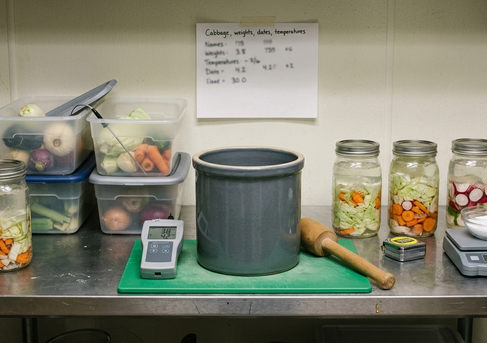
Fermented vegetables bring more than microbes. They carry acids, enzymes, fiber, and minerals that help organisms survive the meal environment. Recipes in Nourishing Traditions are useful because they keep the method grounded in traditional preservation: salt, vegetables, time, and a jar that stays clean.
For lactofermented vegetables, use a salt level of 2% to 3% by vegetable weight. That equals 20 to 30 grams of unrefined salt per 1 kilogram of shredded vegetables. Keep the vegetables fully submerged under brine and ferment at 65°F to 72°F for 3 to 10 days before moving them to cold storage.
Use small trials, especially with sensitive digestion
Fermented foods can worsen symptoms in someone with histamine sensitivity if introduced at cup-sized servings instead of teaspoon-sized trials.
Begin with 1 teaspoon of fermented vegetable brine or vegetables with one meal daily for 3 days. If there is no marked bloating, diarrhea, or histamine-type flushing, increase to 1 tablespoon.
Cultured dairy fits differently. Amasai and other probiotic-rich cultured dairy foods are best introduced in 2- to 4-ounce servings, preferably with meals, because fat and protein buffer stomach acid and slow transit. A probiotic whey-style beverage such as SueroViv can be trialed in 1- to 2-ounce portions between meals when the goal is a lighter fermented drink rather than a full dairy food.
Bottom Line: The gut-rebuilding sequence is not “more probiotics.” It is the right fermented food, at the right dose, with enough time to read the response.
How Can You Maximize Nutrient Absorption in Everyday Meals?
Build absorption into the meal
Improve absorption before adding more supplements. This is one of the least glamorous shifts in traditional-food nutrition, and it is also one of the most useful.
Bone broth is selected because acidulated simmering draws minerals and gelatinous compounds from bones and connective tissue. Combine 2 to 3 pounds of bones with enough filtered water to cover by 1 to 2 inches. Add 1 to 2 tablespoons of raw apple cider vinegar and let the pot rest for 30 to 60 minutes before heating.
Simmer poultry bones for 6 to 12 hours. Simmer beef or lamb bones for 12 to 24 hours. Keep the pot at a gentle simmer rather than a rolling boil to limit emulsified scum and burnt flavors. Apple cider vinegar helps solubilize calcium, magnesium, and phosphorus from the bone matrix into the broth.
Cook some vegetables on purpose
Raw is not always the highest-nourishment choice. Spinach contains oxalic acid, which can bind calcium. Steam or sauté spinach for 3 to 5 minutes, then drain excess liquid if oxalate reduction is the priority.
Spinach also contributes lutein and zeaxanthin, carotenoids concentrated in the retina and commonly discussed in relation to macular degeneration risk. In a prevention-minded diet, cooked spinach can be more useful than a large raw smoothie that leaves a sensitive person bloated or mineral-depleted.
Season with minerals, not stripped salt
Use unrefined Celtic Sea Salt instead of processed table salt when seasoning meals. The point is not to make food salty. The point is to stop treating minerals as an afterthought.
Which Fats Are Truly Safe for a Whole-Food Diet?
Choose fats by chemical stability first, processing history second, and culinary use third.
Coconut oil belongs in the safe-fat category
Extra virgin coconut oil is a therapeutic saturated fat because its saturated structure is more stable under gentle heat than fragile polyunsaturated oils. Start with 1 to 3 teaspoons daily and increase only as tolerated. Sudden tablespoon-level intake can cause nausea or loose stools in sensitive people.
Unrefined coconut oil is best kept below roughly 350°F. Use it for gentle sautéing, baking, and warm beverages, not repeated high-heat frying.
Avoid hydrogenated fats
Trans-fatty acids are the opposite of traditional fat wisdom. Watch for ingredient terms such as “partially hydrogenated oil,” “shortening,” and “hydrogenated vegetable oil,” especially in frostings, shelf-stable baked goods, microwave popcorn, and non-dairy creamers.
For leftovers containing visible fat, reheat on the stovetop or in a low oven until steaming hot rather than microwaving in plastic containers. Microwaving fatty foods can damage naturally occurring cis-fatty acids and push the meal further away from the chemistry the body recognizes.
Use source guides, then verify locally
Traditional-food shopping guides from nonprofit nutrition groups can help verify sources for butter, tallow, lard, coconut oil, olive oil, and fermented foods. The Weston A. Price Foundation is one starting point for that kind of source-checking.
These filters still require household-level tolerance checks; beyond-organic is not a purity grade. It is a disciplined way to ask whether a food is traditionally prepared, minimally distorted, and actually tolerated by the person eating it.
Bottom Line: Transition slowly: log symptoms, simplify ingredients, verify dairy, rebuild flora, cook for absorption, and choose fats that can survive the way you use them.