| |
Sprouts Have The Highest Concentration Of Nutrition Per Calorie Of Any Food
Sprouts are rich sources of vitamins, minerals, trace minerals,
enzymes, antioxidants, chlorophyll and protein. They are low calorie
and contain little or no fat. The fat they do contain is the healthy
fat that your body needs. As some of the most
nutritious foods that exist, they make a great addition to any
healthy eating
plan. Use in salads, on sandwiches,
added to soups or stir fried with vegetables. Enjoy these nutrient-packed delicacies as a
snack all by themselves or added as a garnish to a main dish. Eat them
raw or cooked. Of course, as with all food, the nutritional value is
greater when they are eaten raw. But eating them cooked is better than
not eating them at all.
Sprouting magnifies the nutritional value of the seed. It boosts
the B-vitamin content,
triples the amount of vitamin A and increases vitamin C by a factor of
5 to 6 times. Starches are converted to simple sugars, making
sprouts very easily digestible.
You can have them fresh all year round, even when fresh vegetables
are hard to find. It's easier than planting a garden
outside and they're ready much quicker. You can even grow them
when the ground outside is frozen solid. And the best part is that you
can grow the freshest, tastiest
sprouts right in the comfort of your own kitchen. It takes less than 2
minutes a
day and they are ready in 3 to 7 days, depending on the variety.
You can sprout seeds, beans, grains and nuts. Some of the most popular
varieties are alfalfa, broccoli, red clover, radish, mung beans, lentils,
garbanzo beans and peas.
Alfalfa sprouts are what people typically think of when you mention
sprouts. They are the ones you commonly see at a salad bar. Rich in
phytochemicals, they
protect against cancer, heart disease, osteoporosis and fibrocystic
breast disease. They stimulate natural killer cell activity, which
strengthens the immune sustem. What's more,
they are beneficial in reducing symptoms of PMS and menopause,
including hot flashes. Furthermore, they contain high concentrations of
antioxidants, the body's defense against the destruction of DNA
which is the cause of aging. Alfalfa sprouts are abundant sources of
vitamins A, B, C, E and K, the minerals
calcium, iron, magnesium, phosphorus, potassium and zinc. Also
carotene, chlorophyll, amino acids and trace elements.
They contain 35% protein. One pound of alfalfa seed produces 10-14
pounds of sprouts.
Broccoli sprouts have just recently become popular after it was
discovered that they abound with the amazing cancer-fighting
phytochemical, sulforaphane. Research studies have shown that they
contain 50 times more sulforpohane than fresh
broccoli. What's more, they contain glucosinolates and isothiocyanates,
substances that protect cells from becoming malignant, at 10-100 times
greater levels than in fresh broccoli. In additon, they are sources of
plant estrogens, similar to human estrogen, and so are helpful in
cases of PMS, menopause, hot flashes and fibrocystic
disease. Nutrient dense, they are rich sources of vitamins
A, B, C, E and K,
anti-oxidants, the minerals calcium, iron, magnesium, phosphorus,
potassium and zinc. Also
carotene, chlorophyll, amino acids, trace elements and antioxidants.
Broccoli sprouts contain as much as 35% protein.
Garbanzo beans, also known as chickpeas, can be sprouted to make
delightfully delicious hummus. It is much richer in nutrients than
hummus typically made from cooked chickpeas. They can also be
used in salads, soups or stir fried or steamed with other bean sprouts
and
vegetables. These sprouts are plentiful sources of vitamins A, C and
E, the minerals iron, calcium, magnesium and amino acids. They
contain 20% protein.
Pea sprouts are delicious raw or cooked. They can be sprinkled on
salads and added to soups. In addition, they can be steamed or stir
fried with other bean sprouts and vegetables. They are rich sources of
vitamins A, B, C and E, all the essential
amino acids, the minerals calcium, iron and phosphorus.
They contain 26% protein.
Lentil sprouts, like pea sprouts, are very tasty and can be eaten raw
or cooked. Add them
to salads, soups, casseroles or steam or stir fry them with other
vegetables. Rich in vitamins A, B, C and E, the minerals
iron, calcium and phosphorus. They contain 26% protein.
Mung bean sprouts are the ones you typically see in Oriental
cooking. Mung beans should be sprouted in the dark to avoid a bitter
flavor. They are ready when they are 1.5 to 2 inches long. Abundant in
vitamins A, B, C and E, the minerals iron, potassium, calcium and
magnesium, and amino acids, they contain 20% protein.
Radish sprouts taste just like radishes. They are great on sandwiches
or in salads. Their high concentrations of phytochemicals help
protect against disease. And because of their naturally occurring plant
estrogens, similar to human estrogen, they are helpful with PMS,
menopause, hot flashes and
fibrocystic disease. These baby green vegetables are rich sources of vitamins
A, B, C, E and K, the minerals
potassium, calcium, iron, phosphorus, magnesium and zinc. In addition,
they also contain carotene, chlorophyll, amino acids, trace elements,
and antioxidants. They have a 26% protein content.
Red clover sprouts look like alfalfa sprouts and have a mild, sweet
flavor. Rich in phytochemicals, in particular genistein,
which is known to prevent the formation of new blood vessels inside
a tumor, in essence starving the tumor, it is protective
against diseases like cancer. Red clover contains naturally occurring
plant
estrogens, similar to human estrogen, so they are helpful with PMS,
menopause, hot flashes and
fibrocystic disease. They are contraindicated
with tamoxifen treatment. Please consult your physician if you are
receiving this treatment before using sprouts.
They contain vitamins A, B, C, E and K, the minerals calcium, magnesium,
potassium, iron, phosphorus and zinc, trace minerals, carotene,
chlorophyll and amino acids. They contain 26% protein.
How to Grow Your Own Sprouts
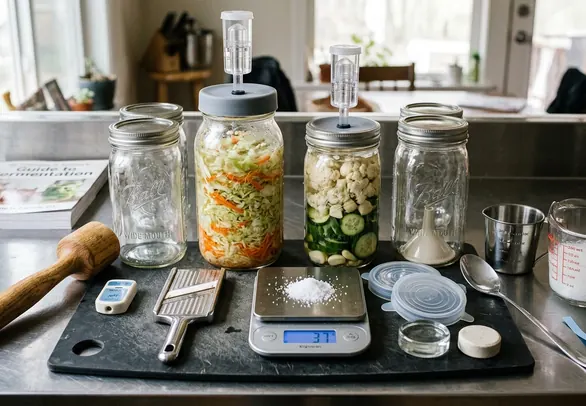
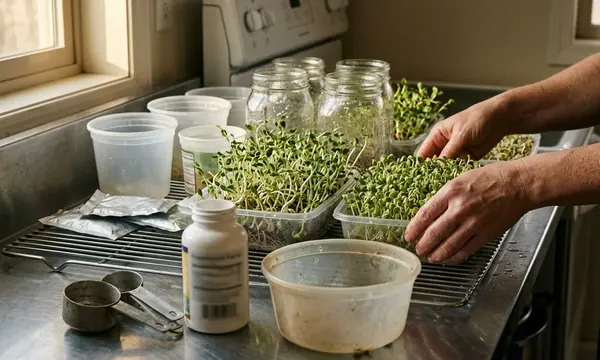
Sprouts are easy to grow and take a minimum of effort. You probably
already have everything you need to start your own kitchen garden.
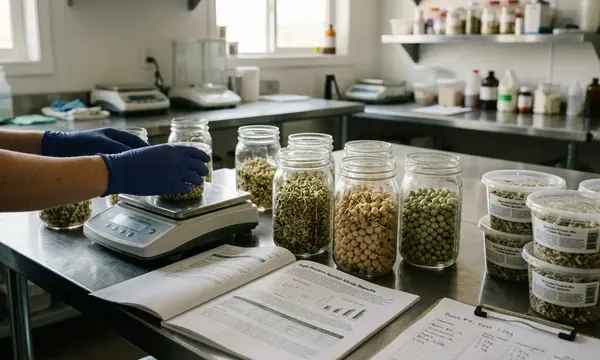
To grow sprouts in jars on your kitchen sink, you will
need:
1. a wide-mouth jar
2. screen or netting
3. a rubber band
4. a bowl to drain the jar
5. fresh water
6. sprouting seeds
Organically grown sprouting seeds are preferable. Seeds that are
not specifically sprouting seeds and are not organic may be chemically
treated with pesticides and those chemicals will end up in your sprouts.
Two oz. of seeds will yield 1-2 pounds of sprouts, and
8 ounces of beans will yield 1 pound of sprouts. Your indoor garden will grow best
when the temperature is between 65F and 75F (18C and 25C).
Step 1.
Put 1 to 2 Tbsp. of seeds or 3 to 4 Tbsp. of beans in a wide mouth jar.
Step 2.
Cover with netting or cheescloth and secure with a rubber band.
Step 3.
Rinse a couple times, then fill the jar 3/4 full with pure water, room
temperature, and soak 6-8 hours or overnight.
Step 4.
Drain soak water. Rinse 2 or 3 times in cool water.
Step 5.
Invert jar and prop at angle in sink or bowl to drain.
Step 6.
Rinse 2 or 3 times twice a day in cool water.
Step 7.
Place sprouting jar in bright light, but not direct sunlight, last
sprouting day to allow chlorophyll to form.
Step 8.
Enjoy In three to seven days.
Seed sprouts, like alfalfa or red clover are 1" (2.5 cm) to 2" (5 cm)
long when ready.
Bean sprouts, like lentils or peas are 1/4" (.5 cm) to 1/2" (1 cm)
long when ready. These are more tender when small.
Mung beans are 1" (2.5 cm) to 2" (5 cm) long when ready. They are
best grown in the dark to prevent bitterness. They should be rinsed
3 to 4 times a day.
Taste the sprouts as they are growing to see when you like them best.
Step 9.
Drain well. Cover the jar with a lid, or transfer
to a covered container. Refrigerate to store.
Are Sprouts Safe?
Sprouts have been grown and eaten for over 5000 years.
They are a concentrated storehouse of phytochemicals which protect
against disease. These mini vegetables are some of the healthiest and safest foods
available today.
In 1995 there were 2 outbreaks of salmonella poisoning that were
attributed to alfalfa sprouts. Both of these outbreaks were traced back
to contaminated seed that was imported from the Netherlands.
Consequently, sprouts received a lot of bad publicity and children and
people with compromised immune systems were advised to avoid them.
But, is there really cause for concern about the safety of sprouts?
Let's look at the facts and put things in perspective.
The cases of salmonella poisoning related to alfalfa sprouts amounted
to 1/3 of 1% of all the cases of salmonella poisoning for that year.
Ninety-three percent of all the cases of salmonella poisoning were attributed to meat.
Seven percent resulted from shelfish, fresh fruits and vegetables. Is there any
government agency telling you not to eat meat, shellfish or fruits and
vegetables?
The protective measures that the FDA is taking to assure the safety of
sprouts includes bleaching sprouting seeds to kill any contaminants
and irradiating sprouting seeds. Irradiation of commercially grown
sprouting seeds to
reduce microbial pathogens has already been approved. But beware. The
sprouts grown from these seeds are not required to be labeled as
irradiated. Only organically grown seeds cannot be irradiated. So if
you want to be sure not to purchase irradiated seeds, make
sure you get organic ones.
Sprouts are safe for everyone. It's the way they are handled that
could cause a
problem. Those related to the salmonella outbreak were
commercially grown. Organic seeds have never been implicated
in a single case of
salmonella poisoning. Certified organic seeds are handled in a manner
that minimizes any possiblity of contamination. Choosing only
organically grown sprouting seeds and growing
your own sprouts will give you one of the safest, healthiest, most
nutritious foods available anywhere.
Books About Sprouting
The Broccoli Sprouts Breakthrough: The New Miracle Food for Cancer Prevention
by Deborah Mitchell presents information of purchasing and growing
your own broccoli sprouts, their nutritional benefits and recipes using
these and other cancer-fighting foods.
Sprout Garden - Revised Edition
by Mark Matthew Braunstein gives the latest information on growing
every kind of sprout and all the different methods.
Sprouts The Miracle Food: The Complete Guide to Sprouting
by Steve Meyerowitz is a step-by-step guide to growing 30 different
varieties of sprouts. Also included are illustrations and comprehensive
nutrition charts.
The Sprouting Book
by Ann Wigmore tells how to grow sprouts by various different methods.
It also includes recipes.
Disclaimer: Every effort has been made to insure the accuracy of the
information presented on this web page. However, nothing on this web
page should be construed as medical advice or used in place of medical
consultation. Please consult your physician or seek out the services of
an alternative health care provider knowledgeable in nutrition.
Powered by Site Build It!
© copyright 2002-2004, HealthyEatingAdvisor.com. All rights reserved.
The Healthy Eating Advisor,
P.O. Box 462335,
Escondido, CA 92046-2335
Telephone(760)735-8101
|