Why Organic and Plant-Based Labels Leave Gut Questions Unanswered
A carton of organic oat milk, a flavored yogurt, and a gluten-free loaf can all look reassuring in the shopping basket. Their front labels tell you little about the ingredients used to keep them creamy, thick, or evenly mixed.
Organic certification and plant-based claims do not measure intestinal mucus, permeability, or inflammation. That is the label-reading paradox: a product can meet the preferences that brought you to the health-food aisle while still containing texture modifiers worth examining.
Emulsifiers help disperse liquids that otherwise separate, such as oil and water. Stabilizers can slow separation by thickening the surrounding liquid. These functions overlap in food manufacturing, but they describe different physical effects. Keeping a beverage evenly mixed also does not establish that an ingredient prevents microbial spoilage.
I start with the ingredient panel rather than the claim on the front. For this article’s audit, use three everyday targets: plant-based milk, flavored yogurt, and gluten-free bread. Check what each actually contains; the category alone cannot tell you.
How Emulsifiers May Change the Colon’s Mucus Barrier
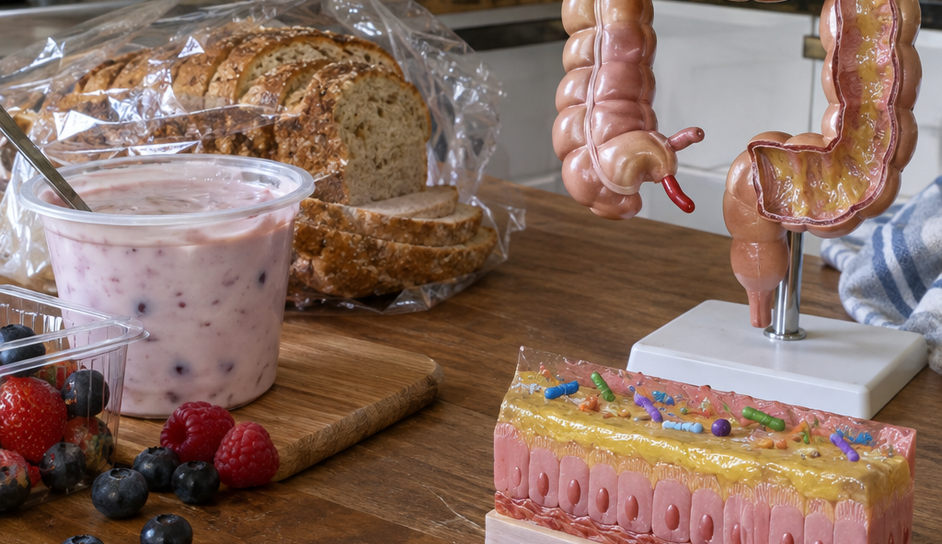
The colon maintains a physical boundary between its microbial population and its epithelial cells. MUC2, its principal gel-forming mucin, helps form an inner mucus region that normally restricts bacterial access and an outer region where microbes live. This two-layer description applies specifically to the colon.
Does “Detergent-Like” Explain Every Additive?
Polysorbate 80 is a surfactant: its water-attracting and fat-attracting components help it act at interfaces. Carboxymethylcellulose, also called cellulose gum, is a cellulose-derived thickener. Assigning both the same mucus-stripping mechanism simply because they stabilize food skips an important chemical distinction.
Experimental work examines several possible effects, including altered mucus organization, changed microbial behavior, and bacterial movement toward the epithelium. Closer bacterial contact can engage local immune signaling. The research published in Nature examining dietary emulsifiers and gut microbiota provides animal evidence relevant to these questions.
A controlled-feeding study published in Gastroenterology in 2022 enrolled 16 healthy adults. Seven received 15 grams of carboxymethylcellulose daily, while nine ate an otherwise comparable emulsifier-free diet, for 11 days. The investigators reported changes in microbiota composition and the fecal metabolome; two recipients showed bacterial encroachment into the normally protected inner mucus region.
Keep Exposure In View
The experimental 15-gram dose cannot tell you how much cellulose gum is in your oat milk. Animal findings and this small, short human trial also leave ordinary dietary effects uncertain, particularly across different additives and baseline microbiomes.
Carrageenan and Polysorbate 80 Have Different Chemical Identities
Seaweed origin answers a sourcing question. It does not settle a gut-health question.
Carrageenan is a family of polysaccharides extracted from red seaweeds, including Chondrus crispus. It principally thickens or stabilizes foods and may appear as E407. Polysorbate 80, or E433, is an ethoxylated sorbitan fatty-acid ester used as a surfactant emulsifier.
Food-Grade Carrageenan Is Distinct From Poligeenan
Food-grade carrageenan commonly has molecular weights in the hundreds of kilodaltons. Poligeenan is a much smaller material, commonly described around 10–20 kilodaltons, produced through harsh acid processing. Poligeenan is not an approved food additive.
Normal digestion should not be described as reliably converting food-grade carrageenan into poligeenan. Questions about degradation require attention to the actual conditions and material tested.
The same care applies to microbiome claims. Reduced fecal short-chain fatty acids in the carboxymethylcellulose feeding trial do not establish that carrageenan and polysorbate 80 consistently suppress Faecalibacterium, or encourage the same mucus-degrading organisms. Carrying a finding from one additive to another can make the evidence sound broader than it is.
A Three-Pass Audit for Everyday Emulsifiers
“Which ingredient should I look for first?” Start with products you consume repeatedly. A useful audit captures both the ingredient name and the eating pattern around it.
- Identify regular purchases. Check almond and oat milks, cottage cheese, whipping cream, nut butters, salad dressings, and dairy-free frozen desserts. Formulations differ within every category.
- Match names and synonyms. Cellulose gum means carboxymethylcellulose, also listed as E466. Polysorbate 80 is E433; polysorbate 60 is E435. Look separately for carrageenan, mono- and diglycerides, sorbitan monostearate, and lecithins.
- Record a week of use. During a seven-day household audit, note the ingredient, labeled serving size, and servings consumed. Then compare alternatives serving the same culinary purpose.
Group Ingredients by Function
- Surfactant emulsifiers: polysorbates help maintain dispersions.
- Thickeners and stabilizers: cellulose gum and carrageenan principally alter texture and physical stability.
- Other emulsifying ingredients: mono- and diglycerides, sorbitan monostearate, and lecithins also have emulsifying uses.
This grouping avoids an unsupported universal ranking of “high-risk” and “gentle” additives. Guar gum, locust bean gum, and lecithin are not whole foods, and botanical starting materials do not automatically establish better mucus tolerance.
Names Are Not Doses
Ingredient order does not reveal an additive’s dose in grams. Use your record to identify repeated exposure and compare formulations, without treating it as a calculation of intestinal injury.
Replace Texture Functions With Simple Kitchen Methods
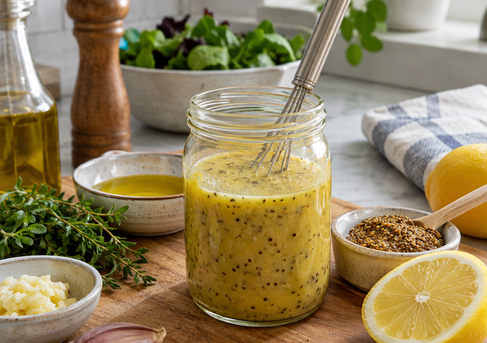
Choose an alternative according to the job the additive performs. Shaking redistributes separated nut milk. Straining concentrates yogurt. Mustard helps a dressing remain dispersed.
- For nut milk: a nuts-and-water beverage has two declared ingredients. Before replacing a fortified drink, compare protein, calcium, vitamin D, and vitamin B12 on the nutrition panels.
- For thick yogurt: choose a traditionally fermented yogurt strained for thickness rather than thickened with gums.
- For vinaigrette: combine one tablespoon of vinegar with one teaspoon of mustard, then whisk in three tablespoons of oil. Mustard supplies compounds and particles that help stabilize the dispersion.
- For yolk-based dressing: use pasteurized egg yolk when serving it uncooked, particularly for pregnant people, young children, older adults, or immunocompromised people.
Oil rising in peanut butter and sediment forming in nut milk are handling cues. Neither proves that a product contains no additives; the ingredient panel still matters.