Navigating Candida questions can feel like reading a label full of ingredients you recognize but do not quite trust. The safest starting point is not panic. It is pattern review: what changed, when it changed, and whether your symptoms line up with a recent flora-disrupting trigger.
At-home Candida screening can be useful when it stays in its lane. A morning saliva glass can give you something to observe for a few days, but it cannot diagnose an infection or tell you which organism is present. Because saliva stringing can reflect mucus as easily as yeast, I treat this topic as pattern review rather than proof.
What's Inside
- What Is Candida Albicans and Why Does It Overgrow?
- How Do You Perform the Morning Saliva Test?
- What Causes Candida to Multiply Out of Control?
- What Are the Systemic Manifestations of Candidiasis?
- What Are the Limitations of At-Home Candida Testing?
- How Can You Restore Your Intestinal Flora Balance?
- Case Study: Overcoming Candida Without Rigid Dieting
What Is Candida Albicans and Why Does It Overgrow?
Candida albicans is commonly discussed as a yeast-like fungus that can live on mucosal surfaces, including the mouth, gastrointestinal tract, and genital tract, without causing symptoms. In plain language, it can be part of the normal neighborhood. A research review describes Candida as a fungal component of normal intestinal flora, which matters because the presence of yeast is not the same thing as disease.
The decision point is a change in pattern. New bloating, a coated tongue, recurrent yeast-type irritation, sugar cravings, or fatigue after meals becomes more meaningful when it appears after antibiotics, high-sugar eating, corticosteroid use, immune-suppressing medication, or a recent gastrointestinal illness.
Christine H. Farlow, D.C., whose work through KISS For Health Publishing and the book Dying To Look Good often frames Candida through a whole-body lens, emphasizes biological balance rather than a war-on-yeast mindset. That distinction helps. When the gut environment becomes less resilient, a normally contained organism can behave differently.
When “systemic” needs a careful definition
Systemic candidiasis should not be used casually for every digestive flare. Medically significant spread beyond local mucosal overgrowth is a serious concern, especially in people with major immune suppression, central lines, recent hospitalization, or serious underlying illness. If that context fits, home screening is not the right first step.
How Do You Perform the Morning Saliva Test?
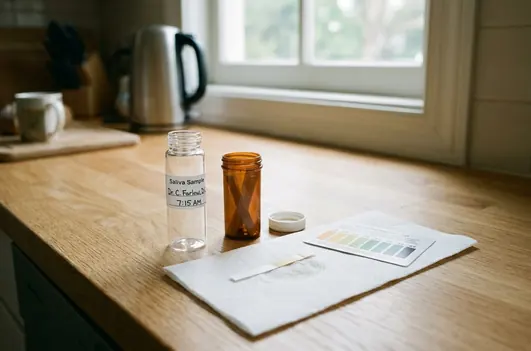
The morning saliva test is an observational screening ritual, not a laboratory method. During protocol evaluations, its value comes from consistency. If you change the timing, the water temperature, or your mouth routine, the result becomes harder to interpret.
Step-by-step method
- Place 6 to 8 ounces of room-temperature water in a clear glass. Very cold water can thicken saliva and exaggerate stringing.
- Run the test within 5 minutes of waking.
- Do not drink water, eat, brush, floss, scrape the tongue, smoke, chew gum, or use mouthwash first.
- Spit once into the water without forceful coughing.
- Set the glass against a light background.
- Observe it at 5, 15, and 30 minutes.
- Repeat the same process for 3 consecutive mornings.
Commonly cited “positive” visual signs include thin strands descending from the saliva layer, cloudy specks suspended below the surface, saliva sinking toward the bottom, or the water becoming diffusely cloudy. Record what you see rather than trying to remember it later.
Field Note: A dehydrated mouth-breather with postnasal drip may show stringy saliva in water even without Candida overgrowth. That is why one cloudy glass does not carry much weight by itself.
Safe At-Home Candida Screening Checklist
- Use a clear glass and 6 to 8 ounces of room-temperature water.
- Test within 5 minutes of waking.
- Do not eat, drink, brush, floss, scrape the tongue, smoke, chew gum, or use mouthwash first.
- Spit once gently into the water.
- Check the glass at 5, 15, and 30 minutes.
- Write down what you see for 3 mornings in a row.
- Compare the glass observations with symptoms, medications, meals, sleep, and bowel changes.
What Causes Candida to Multiply Out of Control?
Medication history is often the cleanest place to start because it gives you a timeline. Look back, from treatment records when possible, over the previous 30 to 90 days for antibiotics and the previous 7 to 30 days for frequent NSAID use.
Tetracycline-class antibiotics, often used for acne, deserve special attention. These medications may be prescribed for multi-week courses, which gives more opportunity for shifts in intestinal and mucosal flora than a brief antibiotic exposure. The issue is not that tetracycline is “bad.” What matters is that reducing bacterial competition can make room for yeast-type symptoms to show up in susceptible people.
Other common flora-disrupting exposures
- Repeated antibiotic courses
- Corticosteroids
- Immune-suppressing medication
- High intake of refined sugar or sweet drinks
- Poorly controlled blood glucose
- Recent gastrointestinal illness
- Frequent alcohol alongside digestive irritation
- Low-fiber eating during a stressful period
NSAIDs such as ibuprofen or naproxen are usually discussed in this context because repeated use can irritate the gut lining and may compound digestive imbalance, especially when combined with alcohol, stress, or low-fiber eating.
Important: Recent tetracycline use followed by new bloating, coated tongue, sugar cravings, and recurrent yeast-type irritation is a different context from a single cloudy saliva test in an otherwise well person.
What Are the Systemic Manifestations of Candidiasis?
Localized overgrowth is usually discussed around the mouth, gut, skin folds, or genital tract. Systemic disease implies spread beyond the local mucosal surface and requires medical evaluation.
For home tracking, the more practical question is: do the saliva findings sit inside a larger symptom pattern? Digestive complaints often worth logging include bloating after meals, gas, alternating stool consistency, abdominal discomfort, and increased cravings for sweet or refined-carbohydrate foods.
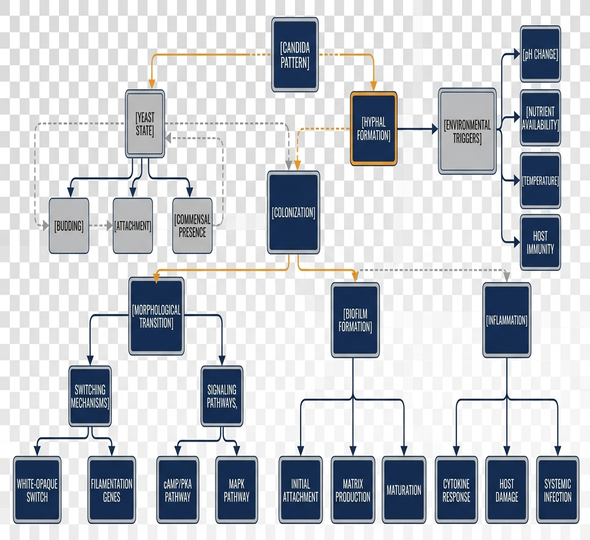
Physical symptoms commonly reported in integrative Candida protocols include a coated tongue, recurrent yeast-type irritation, itching, fatigue after meals, headaches, and symptoms that worsen after high-sugar meals. None of these confirms Candida on its own. Together, they can help you decide whether a clinician, dietitian, or nutrition-literate practitioner should review the pattern with you.
A better comparison than one glass
Pair the 3-morning saliva observations with a 7-day symptom diary. Track meals, medications, bowel changes, sleep, and any vaginal, oral, or skin symptoms. This simple comparison keeps the test from becoming a fortune-telling exercise.
What Are the Limitations of At-Home Candida Testing?
The saliva test is a preliminary screening tool. It does not identify Candida species, measure fungal load, prove intestinal invasion, or distinguish yeast from mucus, food residue, bacteria, or postnasal drainage.
That boundary is not a minor detail. It changes what you do next. A home observation may help you notice a pattern after antibiotics or sugar-heavy eating, but it cannot replace an oral exam, vaginal exam, microscopy, culture, selected stool testing, blood work for competing causes, or urgent assessment when invasive infection is suspected.
When to seek medical care promptly
- Fever or shaking chills
- Confusion
- Severe abdominal pain
- Blood in stool
- Dehydration
- Immune suppression
- Uncontrolled diabetes
- Pregnancy with significant symptoms
- Recurrent infections that return after treatment
Dr. Farlow’s style of guidance is best used as a starting point for food, probiotic, and lifestyle review. Diagnosis and prescription antifungal decisions remain clinical matters.
Bottom Line: A saliva glass observation is a screening practice, not a validated diagnostic test for candidiasis.
How Can You Restore Your Intestinal Flora Balance?
Restoring intestinal flora is usually more workable than trying to micromanage every bite into an overly rigid Candida diet. The goal is to make the gut environment steadier while you watch symptoms honestly.
Probiotics are one targeted method. ThreeLac is a dietary supplement containing live bacteria and is discussed in Candida-focused source material as a way to help manage yeast overgrowth. If someone chooses a probiotic trial, the cleanest approach is to follow the label-directed serving rather than stacking several probiotic products at once. When five products begin on the same day, no one can tell which one helped or caused gas, loose stool, or constipation.
How to run a cautious probiotic trial
- Choose one probiotic product at a time.
- Use the label-directed serving.
- For sensitive digestion, introduce it more slowly over 3 to 7 days.
- Track stool changes, bloating, cravings, skin symptoms, oral coating, and energy after meals.
- Evaluate the pattern over 14 to 28 days.
- Keep refined sugar, sweet drinks, white flour snacks, and frequent alcohol lower during the trial so the signal is easier to read.
This is not about perfect eating. It is about reducing noise. If sweet drinks, late alcohol, and white flour snacks are changing day by day, symptom tracking becomes muddy fast.
Case Study: Overcoming Candida Without Rigid Dieting
The Annette VanVoorst account is useful as a personal report, not as population-level evidence. Annette VanVoorst from Maurice, Iowa, is identified in the source material as having previously used the antifungal drug Nystatin, then moving away from that approach and using the ThreeLac probiotic supplement.
The reported outcome was complete symptom resolution in exactly 11 days after beginning the probiotic regimen. That is a specific claim, and it should stay specific to her case.
For readers, the practical lesson is not to expect the same timeline. A testimonial reporting 11-day improvement after a probiotic supplement does not establish the expected recovery time for people with diabetes, immune suppression, IBS, medication side effects, or an undiagnosed infection.
The more durable lesson is methodological: change fewer variables, track daily symptoms, and keep medical red flags out of the self-experiment category. That is how at-home Candida screening becomes safer and more useful.
Bibliography
- Christine H. Farlow, D.C., KISS For Health Publishing, and Dying To Look Good, referenced for the whole-body framing of biological balance and Candida-focused consumer guidance.